The REACH Center at the University of Washington is an interdisciplinary research team dedicated to developing, implementing, and evaluating interventions that protect health and safety during extreme weather events and environmental conditions. REACH is made up of four cores: Administrative, Research, Community Engagement, and Implementation and Evaluation, and partners with the National Association of City and County Health Officials (NACCHO) to help recruit health departments to participate in health interventions. The REACH Center’s work is funded by an exploratory research grant from the National Institutes of Health (NIH).
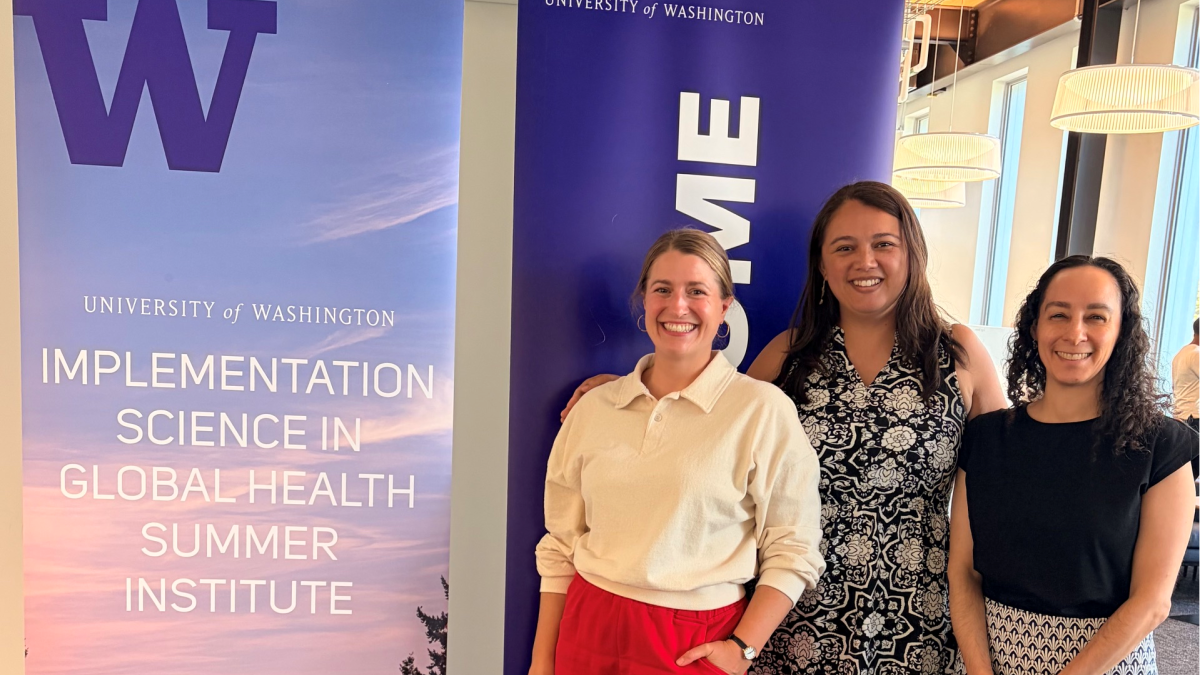
The Implementation and Evaluation Core runs a fellowship program that guides interdisciplinary teams of two to three fellows in designing and executing projects that use implementation science to evaluate or improve uptake of evidence-based climate and health adaptation strategies. One of those fellowship teams, the Climate Cafés Team, is working to build community resilience in Washington County, Oregon, through meaningful, facilitated, and culturally responsive conversations about climate change and its lasting impacts. The team includes Adelle Monteblanco, PhD, of Pacific University, and Lauralee Fernandez, PhD, MPH, and Kathleen Johnson, MPH, of the Washington County Public Health Division.
Shaping climate café experiences
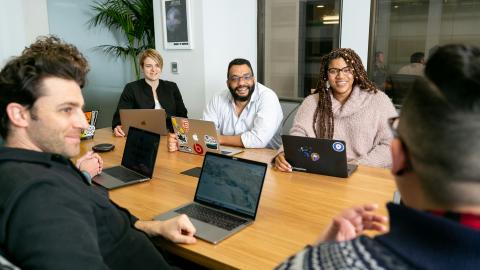
“Climate cafés” are facilitated, small-group discussions that support emotional processing of climate change-related distress and build social connection among participants.
Drawing on a line from a young activist, Maksim Batuyev, on the Climate Conversation and the Kid Question podcast, Monteblanco describes climate cafés as a chance to explore “how are you doing?” with the climate crisis, not “what are you doing?”
The team’s project is titled "Conversation to Connection: Evaluating the Impact of a Community-Wide Climate Café Model." They’re working with community-based organizations to create a climate café model that fits communities in Washington County, Oregon.
A recent Tri-County [Washington, Multnomah, and Clackamas counties] mental health survey found real weight behind that need: 72% of Washington County respondents reported being affected by extreme weather events, with many describing frequent sadness (59%), anxiety (58%), or helplessness (54%) tied to climate change.
In-person and virtual climate cafés can help combat these feelings and provide a structured environment where participants can share their experiences, reduce feelings of isolation, and strengthen their collective resilience in response to climate change.
“Our hope is that climate cafés can be a safe space to share diverse emotions and an opportunity to build trust and relationships with the community,” says team member Lauralee Fernandez, an environmental epidemiologist focused on community-based research and environmental justice. As Washington County's Public Health Emergency Preparedness and Environmental Health Epidemiologist, she has helped strengthen climate emergency surveillance and shape adaptation planning through a lens focused on vulnerability and resilience.
Climate cafés are so valuable because they help normalize emotional expression. They foster community through emotional exploration and support community resilience. Resilience relies on the capacity to understand each other and engage in discussions about challenging topics, even when solutions aren't clear. Climate cafés are spaces to build those skills.
Community and collaboration
For the Climate Cafés Fellowship Team, an interdisciplinary approach isn't incidental. Climate change, they say, is too complex for any single field to address alone; solving it requires combined training, perspectives, and a willingness to learn from one another along the way.
When selecting community partners to host the climate cafés, the Washington County Public Health Division prioritized relationships with organizations deeply embedded in the communities most vulnerable to climate impacts. These partners helped shape outreach and recruitment strategies and develop a framework for culturally relevant climate cafés.
"Complex challenges like the climate crisis cannot be solved by any one discipline alone," says team member Adelle Monteblanco.
Monteblanco is an associate professor and chair of Public Health at Pacific University in Oregon, whose work as an environmental sociologist bridges public health, climate science, and sustainability. Her research centers on extreme heat and its health risks for vulnerable groups, including pregnant people and youth, through projects like heat-safety training for birth workers in El Paso and an urban heat education program for youth in Nashville. She holds a PhD in sociology from the University of Colorado Boulder.
When building models for culturally relevant climate cafés, the team emphasizes that there is no “one-size-fits-all” climate café.
Communities vary in their relationships with climate change and their openness to discussing it. For instance, communities may have different lived experiences of climate impacts, varying levels of comfort with engaging in emotional topics, and different levels of trust in health and public health practitioners. Given this, the team is looking at which methods work for climate cafés in varying settings, evaluating how climate cafés differ, and identifying a thread of common practices that resonate across different communities.
The team anticipates challenges in the long-term application of their model, including sustainability. While climate cafés have been proven to benefit community health, organizations need time, staffing, and funding to continue offering them. Sustaining the model means it must be part of the organization’s ongoing operations, not a one-time initiative.
Anticipation, growth, and learning
The Climate Cafés Team participated in the 2026 Implementation Science Summer Institute in August, where they were excited to learn new approaches to evaluating, refining, and eventually scaling up climate cafés across the country. The team hopes that climate cafés will become a resource for climate change adaptation. By creating space for people to process emotions, strengthen social connections, and have difficult conversations, they can help build the resilience that communities need to adapt to a changing climate.
“This fellowship has deepened my interest in understanding how community-based approaches can contribute to interventions related to climate adaptation" says team member Kathleen Johnson, a public health practitioner focused on the built environment, climate change, and public health. In her role as a Senior Program Coordinator at Washington County, she leads climate change and health programming. “I have become especially interested in uplifting third spaces —places like community centers, libraries, parks, and coffee shops—and how they can be used in new ways, like hosting climate cafés that bring people together to build connection and resilience.”
- Reach Center