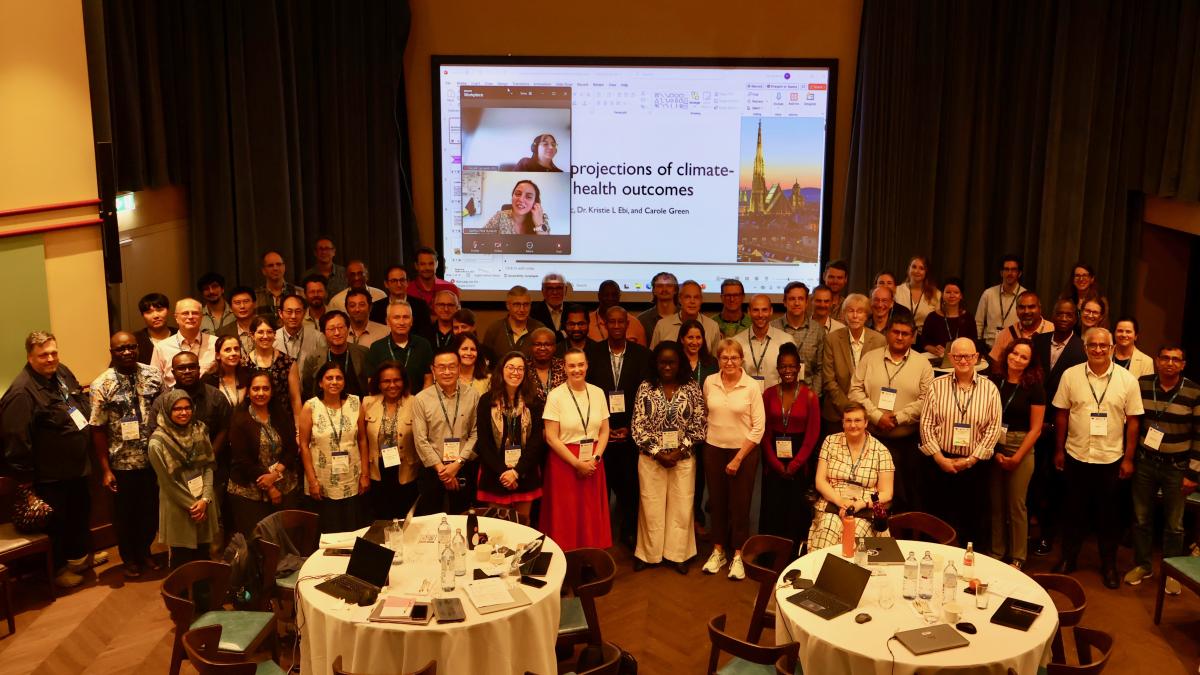
This summer, CHanGE members Kristie Ebi, PhD, MPH, Marci Burden, MA, Jeremy Hess, MD, MPH, and incoming PhD student Carole Green, MPH, traveled to Europe to participate in three important workshops focused on global health and the environment. Funding from Wellcome, a global charitable foundation supporting research on global health challenges, made their participation possible. Conversations at the event highlighted the critical role of socio-economic pathways in understanding environmental risks and guiding equitable adaptation and mitigation strategies. A record-breaking heatwave in Europe during one of the workshops underscored the growing urgency around extreme heat events.
Training scientists on shared socioeconomic pathways in Vienna
From June 23 to 25, the University of Washington in collaboration with the International Institute for Applied Systems Analysis (IIASA), hosted an Extensions workshop in Vienna, Austria, focused on advancing health projections through improved scenario modeling. About 40 scientists from low- and middle-income countries gathered to learn more about the Shared Socioeconomic Pathways (SSPs) and Representative Concentration Pathways (RCPs).
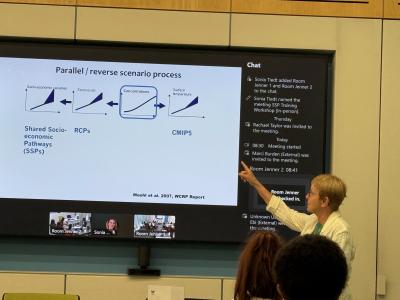
SSPs are a set of five possible scenarios summarizing how the world may evolve over the next century. Each scenario describes a different path various societies may follow and how those paths may affect our ability to adapt and mitigate environmental risks. For example, the first pathway prioritizes sustainable development, low consumption, and reduced inequality, while the fifth pathway emphasizes fossil fuel-driven development and high economic growth. These pathways can be combined with RCPs, estimate different levels of future greenhouse gas emissions, to explore a variety of possible futures and their environmental and health impacts.
The workshop adapted socioeconomic pathways to a public health lens, allowing for more relevant projections of how hazards, such as extreme heat or flooding, may impact health systems globally. Participants collaborated to identify key details, timelines, and regional differences that should be incorporated into these health-focused pathways.
The timing of this workshop made the conversations especially relevant. During the event, Vienna experienced an intense heatwave with temperatures up to 94°F. In contrast to the U.S., where about 90% of buildings and homes have air conditioning, only a small fraction of European spaces have air conditioning, making the heat’s impact more immediate and tangible.
Training scientists at the University of Leeds Scenarios Forum
Two weeks later, the CHanGE team traveled to Europe again to host a specialized training in London for researchers from low- and middle-income countries. Also funded by Wellcome and organized with IIASA, this one-time training provided hands-on guidance on how to use the SSPs and scenario approaches in research. The goal was to equip researchers from low- and middle-income countries with tools to explore how future socioeconomic trends will shape environmental and health challenges.
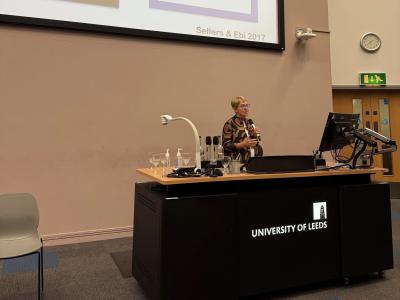
This helped ensure broader representation at the Forum on Scenarios for Societal and Environmental Futures, scheduled for later that week. Hosted by the University of Leeds, the Scenarios Forum brought together researchers across disciplines to share experiences, explore opportunities for collaboration, and identify knowledge gaps in scenario-based research.
Sessions explored themes of urban development, energy transitions, equity and justice, and biodiversity. This event offered a platform for CHanGE members to connect with researchers, exchange ideas, and bring health considerations to the forefront of discussions surrounding environmental change.
Lessons learned
These three events reflect CHanGE’s ongoing commitment to advancing research and training that prepare communities for a broad range of possible futures. By defining the SSPs for health, training researchers from low- and middle-income countries, and fostering connections at the Scenarios Forum, CHanGE faculty and partners are helping ensure that diverse perspectives inform future planning.
Together, these events moved the conversation beyond academic modeling into actionable insights that can inform policy decisions, guide resource allocation, and protect vulnerable communities. As environmental and societal changes accelerate, collaborations like these will be essential to shaping healthier, more resilient futures.
CHanGE would like to extend another thank you to Wellcome for their support in making these conversations possible.
- Faculty Spotlight
- Heat